Inertia vs. Heritage
In France, it is sometimes easier to let a historic landmark decay than to give it a second life.
This statement may sound provocative.
Yet anyone who has ever been involved in the restoration of a heritage property knows that it reflects a familiar reality.
Let us not confuse the issue.
Technical, structural, environmental and heritage assessments are essential. They ensure that our historic legacy is preserved with rigour and responsibility.
The real challenge begins when procedures become an end in themselves; when interpretation outweighs vision; and when decision-making sometimes loses sight of the broader public interest. The unintended consequence is no longer simply the protection of heritage, but the preservation of institutional inertia.
Meanwhile, historic buildings continue to deteriorate. Investors hesitate, businesses wait, and entire regions lose jobs, economic momentum and, sometimes, part of their identity.
France continues to demonstrate that another path is possible.
The redevelopment of the Citadel of Belle-Île-en-Mer is one such example.
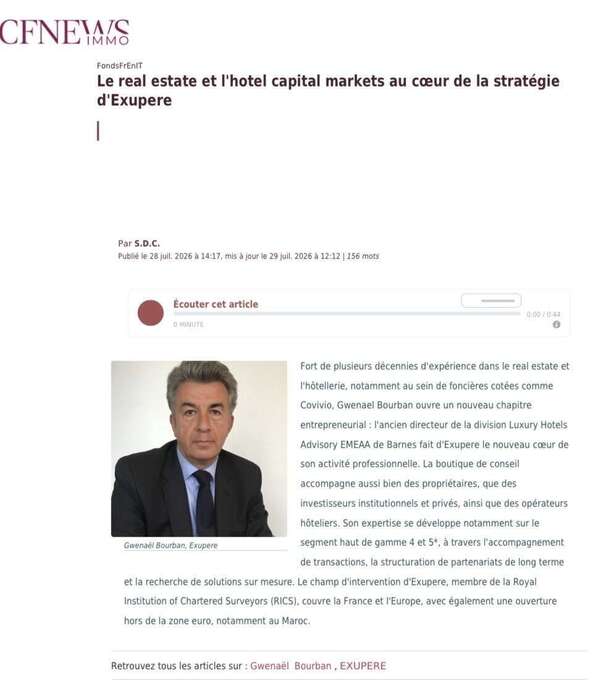
I mention this project with particular interest because, in 2019, I had the opportunity to work on the commercialisation of a portfolio of seven historic château-hotels — the “Seven Portfolio” — including the Citadel of Belle-Île-en-Mer. That experience taught me one essential lesson: major heritage projects are marathons, never sprints.
As with many large-scale heritage developments, it is reasonable to assume that a project of this nature requires several years to bring together technical studies, financing, public authorities, investors and hospitality operators before a new future can be envisioned for an exceptional site.
But time alone is not what determines success. A heritage project must also be built on a sound and sustainable business model. Vision and ambition are essential, but they must be supported by a realistic business model capable of creating lasting value for both the site and the region.
What should concern us far more are delays that no longer result from legitimate technical or heritage requirements, but from obstacles that add no value to either the project or the community. Complexity is not the enemy. Institutional inertia is. Every year lost represents an economic, cultural and human opportunity slipping away.
I remain convinced that projects creating long-term value ultimately move forward. They are driven by vision, built by committed people and sustained by a purpose that goes beyond individual interests.
Reinventing heritage is not simply about restoring historic buildings. It is about giving forgotten places a new purpose, creating jobs, strengthening regional attractiveness and passing on a living legacy to future generations.
Historic stones possess one remarkable quality that we would do well to remember.
They know how to wait.
It is now up to all of us—public and private stakeholders alike—to ensure that our decisions are worthy of the heritage we have inherited and the territories we seek to shape.
Restoring heritage means embracing the long term.
#Exupere #Heritage #HistoricPreservation #Hospitality #Investment #TerritorialDevelopment #Tourism